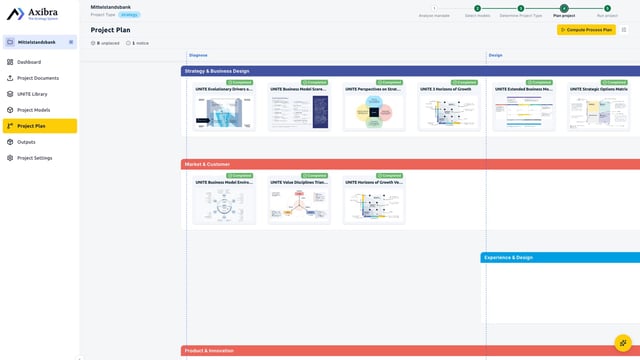
A strategy implementation plan turns strategic choices into owned initiatives with a budget and a defined order, so that every task can be traced back to a decision. Axibra supports this path from the briefing through the models to an implementation plan with work packages and a calculated sequence, and every answer names its source.
Strategy is rarely lost in the analysis; it is lost in the handover from the deck to the plan. Most strategy teams do the analysis well, because they study markets, capabilities and competitors before they agree on a direction. Then the strategy changes hands. A program team receives a slide deck, a delivery team receives a list of initiatives, and somewhere along the way the reasoning behind each choice disappears.
This article reflects the state of October 2026.
This guide follows the four handovers between analysis and plan and shows what each one needs so that the reasoning survives. For every step, we also describe how Axibra supports it.
What does strategy implementation actually mean?
Strategy implementation is the translation of strategic choices into owned tasks with a budget and a defined order. It starts where the strategy document ends. A strategy says where the company wants to play and how it wants to win. Implementation decides which initiatives follow from that, who owns them, in which order they run and how progress is measured.
Many organizations treat the approved strategy deck as the finished product. The deck is presented to the board, circulated to the leadership team and filed. Implementation then starts as a separate exercise, often run by different people with different tools.
A useful working definition has four parts:
- Choices: the strategic decisions the company has made, stated explicitly.
- Initiatives: the projects that follow from those choices.
- Plan: owners and resources for those initiatives, along with the order in which they depend on each other.
- Steering: indicators that the team reviews at a fixed rhythm, so the plan can be adjusted.
The important word in this definition is “follow”. An initiative that cannot name the choice it serves is a project, and a portfolio of such projects is a budget.
Strategy formulation and strategy implementation compared
The two activities answer different questions and produce different results. The table shows where they differ.
| Aspect | Strategy formulation | Strategy implementation |
|---|---|---|
| Core question | Where do we play, and how do we win? | Who does what, in which order, measured against what? |
| Result | Strategic choices in a strategy paper | Implementation plan with initiatives, owners, sequence, resources and measures |
| Typical owner | Executive board and strategy function | Initiative owners, steered by a Transformation Office or PMO |
| Time horizon | Several years | Quarters and months |
| Review rhythm | Annual strategic review | Monthly initiative reviews and a quarterly strategy review |
| Typical risk | Choices stay vague or implicit | Initiatives lose the link to the choices they serve |
For a CSO, a Head of Strategy or a Transformation Office, this has a practical consequence. Your job does not end with a good strategy paper. It ends when every major project can be traced back to a strategic choice. A change in one of those choices should also show up in the plan. The glossary entry on the strategy execution gap describes the distance between those two points in more detail.
Which steps make up strategy implementation?
Strategy implementation runs through six recurring steps, from the strategy retreat to the prioritized portfolio of initiatives. We describe each step in a separate article over the coming weeks.
- Preparing a strategic planning meeting: the retreat produces decisions when the groundwork and the expected outcome are clear before the day begins.
- Adaptive strategic planning: the strategy is updated at a fixed rhythm when assumptions change, instead of being rewritten once a year.
- Cascading goals: corporate goals are broken down into business unit goals, so that every unit knows which objective its work serves.
- Strategic review process: a regular review checks whether the strategic choices still hold and whether the plan still serves them.
- Board strategy paper: the paper for the board presents the choices together with the evidence they rest on.
- Prioritizing strategic initiatives: the portfolio is ordered by each initiative’s contribution to the strategic choices and by the capacity available.
Where does strategy get lost between deck and execution?
Strategy gets lost at the handovers. Each handover passes on a result and leaves behind the reasoning that produced it.
The first handover runs from analysis to choices. A team spends weeks on market data, capability assessments and scenarios. The output is often a set of findings on slides. The choices themselves stay implicit, scattered across speaker notes and the memories of the people in the room.
The second handover runs from choices to initiatives. Someone has to decide which activities follow from the strategy. In practice, many initiative lists collect projects that already existed and give them new labels. The list looks complete, yet nobody can say which initiative serves which choice.
The third handover runs from initiatives to the implementation plan. Owners and dates appear, and budgets follow. The link to the outcome each initiative was meant to deliver fades, because the plan lives in a different tool than the strategy.
The fourth handover runs from the plan to everyday steering. Without a regular operating cadence, daily priorities replace the plan within a few quarters.
At each step, the people involved act in good faith. They simply use what they receive, and what they receive is a result without its origin. Our article on why digital business strategies fade out in execution looks at this decay from the perspective of digital programs.
That is exactly where strategy breaks. The analysis was sound, the choices were reasonable, and the plan still executes something slightly different from what the leadership team decided.
Is it a people problem or a process problem?
It is usually both: leadership and culture shape execution, while the process decides which reasoning reaches the people doing the work. Many practitioners see people as the main reason execution fails. Leadership attention moves on, middle management is overloaded, and the culture rewards firefighting over long-term projects. We take that view seriously, because culture and leadership shape how any plan is carried out.
Committed teams with strong leaders also need a path from analysis to plan without gaps. A delivery lead who receives an initiative without its rationale will make reasonable local decisions. Those decisions add up to something the strategy team did not intend.
Process also shapes behavior. When the reasoning behind a choice is written down and attached to the initiative, people can check their decisions against it. When it is missing, they rely on memory, hallway conversations and their own interpretation.
For your team, the practical answer is to treat both sides together. Leadership needs to sponsor the strategy visibly and repeatedly. The organization needs a path in which every step from analysis to plan stays traceable, so that the sponsorship has something concrete to point at.
A traceable path gives leadership a way to see whether the organization still pursues the strategy it approved. It also gives teams a way to argue with the plan on the basis of its reasoning.
Run one real decision through the system
Bring a live strategy problem — a market entry, a transformation case. We show it as one linked object: the decision, its rationale, the assumptions it depends on, and the workstreams underneath it.
Book a demo20 minutes · with a strategist, not a sales repWhat has to be in place before the plan is written?
Three things should exist before anyone opens a planning template: a briefing, explicit choices and agreed success criteria.
The briefing states the question the strategy answers. It names the scope, the time horizon, the constraints and the people who decide. A good briefing is short and signed off by the sponsor. Without it, every later step has to guess what the strategy was for.
The choices are the decisions the analysis led to. They should be written as sentences a manager can disagree with, for example which customer segments get priority or which capabilities the company will build itself. A vague aim, such as becoming more customer-centric, describes a direction that cannot be planned against.
The success criteria say how you will know that the strategy is effective. They should be agreed before the plan exists, so that the plan is built to meet them and nobody redefines them later.
These three elements are the foundation for everything that follows. Missing any of them means the implementation plan will be built on interpretation.
In Axibra, a project also starts with a briefing. From there, the software selects fitting models from its model library and leads to an implementation plan with work packages. Every answer names its source, so a question about the plan months later can be traced back to where it came from. You can read more about this flow on our platform page.
How do you turn analysis into strategic choices?
Analysis produces findings, while a strategy needs choices, and models earn their place in the step between the two.
A model gives the analysis a structure that forces a decision. A business capability map shows which capabilities the company has and which it needs, so the team has to decide where to invest. The UNITE Strategy-Execution framework sorts the areas of a business into non-core, core and differentiating, so the team has to decide where to cut costs and where to innovate. The Three Horizons Model sorts initiatives by time horizon, so the team has to decide how much effort goes into today’s business and how much into new options. A strategy map connects objectives across perspectives, so the team has to state how one objective supports another.
A model only helps when the team fills it in and commits to what it shows. A filled capability map with three capabilities marked for investment is a choice. A capability map discussed in a workshop and never filled in is a conversation.
For each model you use, write down three things:
- the question the model answers,
- the choice the team made with it,
- the analysis that supported that choice.
This record is short, often half a page per model. It becomes the reference that every later step points to. When someone asks months later why the company invests in one capability and not another, the answer is on that page. How analysis, options and decision fit together as a whole is described in our article on the strategy development process.
Axibra draws on the UNITE model library and on an ontology that describes which building blocks a company has and how they connect. Based on the briefing, the software selects the models from that library that fit the question, and your team works with them. Every answer names its source, so the origin of a choice stays visible when the plan is built.
How do strategic choices become initiatives?
An initiative is a project that changes something the strategy requires to change. Each initiative should answer three questions before it enters the plan: which choice it serves, which capability or process it changes, and which outcome it will be measured against.
Most organizations already have a portfolio of running projects when a new strategy arrives. The temptation is to map those projects onto the new strategy and call the result an initiative list. Some of those projects will fit. Others will continue because they already have a budget and a team.
A cleaner method starts from the choices. For each choice, your team asks what has to be different in twelve or twenty-four months for the choice to be real. The answers describe outcomes. The initiatives are the activities needed to reach those outcomes. Only then do you compare the result with the running portfolio and decide which projects to keep, change or stop.
A short initiative record makes this traceable. It names the initiative, its owner, the choice it serves, the outcome it targets and the measure used. If a line in that record stays empty, the initiative is not ready for the plan.
Template: initiative record
Copy the table and fill in one record per initiative. An initiative enters the plan only when every row has an entry.
| Field | Entry |
|---|---|
| Initiative | … |
| Owner (one named person) | … |
| Strategic choice it serves | … |
| Capability or process it changes | … |
| Target outcome in twelve to twenty-four months | … |
| Measure with baseline and target level | … |
| Depends on | … |
| Resources (budget, people, time) | … |
The opportunity solution tree is a useful pattern here, because it links outcomes, opportunities and solutions in one visible structure.
In Axibra, the ontology is the structure every project runs along, and every answer names its source. That makes it easier for your team to say why an initiative exists.
What belongs in a strategy implementation plan?
A strategy implementation plan is the document that turns initiatives into a schedule of owned, resourced and measurable tasks. It has six components, and each one should point back to the decision it came from.
- Objectives: the outcomes the strategy requires, each linked to a strategic choice.
- Initiatives: the projects that deliver those objectives, each with its rationale.
- Owners and decision rights: one accountable person per initiative and clear decision rights for changes.
- Sequence and dependencies: the order of tasks, based on what has to exist before something else can start.
- Resources: budget, people and time allocated per initiative.
- Measures: indicators with baselines and target values, agreed before the initiative starts.
A spreadsheet with these six columns is easy to build. What it usually lacks is the link between them. An objective sits in one table, an initiative in another, a measure in a third, and the reader has to reconstruct how they belong together.
The test for a good plan is simple. Pick any line in it and ask where it comes from. A traceable plan answers with a chain: the task belongs to an initiative, and the initiative serves an objective. The objective follows from a choice, which the team made on the basis of an analysis. A plan that cannot answer stops at the initiative and leaves the rest to memory.
The level of detail depends on the time horizon. For the first two quarters, the plan should name concrete milestones. For later periods, it can stay at the level of initiatives and objectives and be refined in regular reviews.
In Axibra, the implementation plan is the last step of the same flow that started with the briefing. From the decisions, the software generates work packages and an implementation plan, including the calculated sequence, and every answer names its source.
How do you sequence and govern the plan?
Sequencing follows two constraints: dependencies and capacity. Dependencies tell you what has to exist before something else can begin. Capacity tells you how much your organization can carry at the same time.
Start with dependencies, because some initiatives build capabilities that others need, for example a data platform that later product initiatives rely on. Those come first, even when they are less visible. After that, check capacity: if the same team owns four initiatives in the same quarter, the plan is wishful, however good the logic looks on paper.
Governance keeps the plan alive after approval. A Transformation Office or a PMO usually owns the plan as a whole. It tracks progress, resolves conflicts between initiatives and prepares decisions for the steering committee.
The rhythm of that governance is the operating cadence. A common pattern combines monthly initiative reviews with a quarterly strategy review. The monthly review looks at progress and blockers. The quarterly review asks whether the choices still hold and whether the plan still serves them.
In each review, the origin of every step should be visible. When a steering committee discusses delaying an initiative, it needs to see which objective and which choice that delay affects. Without that view, decisions are taken on the basis of budget and urgency alone.
In Axibra, sequencing work packages runs without a language model, so the same briefing produces the same order. Every answer names its source, which gives a review a starting point when it asks which choice a change touches.
How do you keep the plan steerable when conditions change?
A plan stays steerable when your team can see what a change touches before deciding on it. Every implementation plan meets reality within months. A competitor moves, a budget is cut, a key person leaves. A plan that nobody can change makes an organization rigid, which is why strategy also needs room to emerge as conditions shift.
The questions are concrete. If an initiative is delayed, a specific objective suffers. If a strategic choice is revised, some initiatives lose their reason to exist.
A plan that keeps the origin of every step answers these questions in minutes. You follow the links from the changed element upward to the choice and downward to the tasks. The steering committee then decides with the consequences in view.
A plan without that origin forces the team into a different exercise. People reconstruct the reasoning from old decks and meeting notes, and the decision is taken on the basis of whoever remembers most.
Three practices help your team keep that view:
- Review the strategic choices every quarter, and record whether each one still holds.
- When a choice changes, update the plan from the choice downward.
- Keep a change log that names the reason for every adjustment.
In Axibra, every answer names its source. The strategy model is kept, and when assumptions change it is updated as a new version instead of starting from scratch. Your team continues the strategy it has rather than rebuilding it.
Which mistakes break the chain most often?
The most common breaks are initiative lists without choices, plans without owners, metrics without baselines, outdated strategy documents and success criteria set afterwards. Each one is easy to recognize once you know what to look for.
Initiative lists carry no choices. The strategy deck ends with a list of initiatives, but the choices that should justify them are missing or vague. Teams then defend initiatives on their own merits, and the portfolio grows.
Plans have no named owners. An initiative is assigned to a function or a committee. Nobody is personally accountable, so delays are explained and rarely resolved.
Metrics have no baseline. The plan names an indicator but not its starting value. After a year, nobody can say whether the initiative made a difference.
Nobody updates the strategy deck. The strategy is revised informally in meetings, while the official document stays unchanged. The plan follows the document and drifts away from what leadership actually wants.
Teams define success criteria after the fact. When criteria are set once results are visible, they tend to match the results. The plan loses its function as a test.
Each of these breaks has the same root. Somewhere in the chain from analysis to plan, a link was not recorded, and later steps lost the ability to refer back. The remedy is to make every link explicit at the moment it is created, because reconstructing it later costs far more time and is rarely complete.
How Axibra solves this
Our software covers the path from briefing to implementation plan. It guides your team from the briefing through the models to the plan, and every answer names its source. The software addresses the handovers described in this guide, because briefing, models and implementation plan are part of one flow.
In this section we describe how the software operates and which problems it is built for.
From briefing to plan in one sequence
The process starts with a briefing in which your team describes the question. You can add your own documents, for example the strategy paper, market studies or a board presentation, and the software evaluates them as input for the following steps. This evaluation runs without calling a language model.
Axibra selects models and frameworks from the UNITE model library that fit the project. The ontology describes which building blocks your company has and how they connect. A capability question leads to different models than a question about growth options or an operating model. Your team works with those models in the software.
From the decisions, Axibra generates work packages and an implementation plan, including the calculated sequence. Each stage is the input for the next one, so nothing has to be copied from a slide deck into a spreadsheet.
A source for every answer
Every answer in Axibra names its source. When a recommendation appears, you can see where it comes from.
This matters most when people change. The reasoning behind a strategy usually lives in the heads of the people who made it. When they move to another role, the reasoning leaves with them. Because the strategy model is kept and updated rather than restarted, the reasoning stays in the system. A new Head of Strategy or program lead can take over without reconstructing the reasoning from old files.
A rule-based sequence
Work packages are sequenced without a language model. The same briefing produces the same order, and the answer names its source. Their order has consequences for budgets and people, so it should not depend on how a language model happens to respond. A language model is used only to formulate the texts, and only that step needs a connection to the internet.
Your data stays under your control
Strategic planning involves confidential material. Axibra runs locally on your computer, so your data stays with your company, and pseudonymization is the default setting. The software has no chat window, so there is no place where someone pastes a confidential strategy. Details on how we handle data are on our security page.
What changes for your team
For a CSO or a Transformation Office, the practical effect is a single place where the strategy and its execution are connected. Because every answer names its source, your team can see where a recommendation comes from, and the plan grows out of the same flow as the strategy.
Your team does not start from a blank page. The software brings the UNITE model library with it, and your team applies it to your own question with your own material.
A step-by-step walkthrough is on our how it works page. Our platform page gives an overview of the software. Which criteria any strategic planning software should meet, ours included, is the subject of a separate article.
How can you test this approach in your organization?
The most reliable test is a pilot on a real strategic question, with success criteria agreed before it starts. When analysis, choices, initiatives and plan stay connected, your team can trace every task to a decision and change course deliberately when conditions shift.
We offer a working session or a pilot of 3 to 6 weeks. Before it starts, we agree with you on the success criteria, so that the result can be judged against criteria set in advance. You bring a strategic question your team is working on today, and we answer it together in Axibra, from the briefing to the implementation plan.
If you first want to see where your organization stands, the Capability Benchmark is a short self-assessment, and the report arrives by email.
If you want to discuss whether a pilot fits your current situation, you can contact us and tell us which strategic question is on your desk right now.
The key points of this guide:
- Strategy implementation translates strategic choices into owned, sequenced and measurable tasks.
- Strategy gets lost at the handovers between analysis, choices, initiatives and plan.
- A briefing, explicit choices and success criteria agreed in advance come before the plan.
- Models turn analysis into choices that later steps can reference.
- Every initiative names the choice it serves and the outcome it targets.
- A plan stays steerable when every step keeps its origin.
- Axibra connects briefing, models and implementation plan in one flow, and a pilot of 3 to 6 weeks tests it on your own question.
Axibra. The Strategy System.
About the author: Stefan F. Dieffenbacher is Founder & CEO of Digital Leadership AG and author of “How to Create Innovation” (Wiley, 2024 · Chinese edition: China Industry & Commerce Press, 2026). More about Stefan.
Frequently asked questions
A strategic implementation plan turns strategic choices into owned, sequenced and measurable work. It names objectives, initiatives, owners, sequence, resources and measures. In a traceable plan, every element points back to the strategic choice it comes from. Without that link, the plan turns into a list of projects that nobody can connect to the strategy.
Most definitions name objectives, initiatives, owners, timeline and measures. We add resources as a sixth component and treat sequence and dependencies explicitly. What matters more than the list is the link between the components, so that every task can be traced to an objective and a strategic choice.
Five stages follow one another: a briefing that fixes the question and scope, analysis that ends in explicit strategic choices, initiatives derived from those choices, an implementation plan with owners, sequence, resources and measures, and steering through a regular operating cadence. Other sources name the stages differently. Strategy usually gets lost at the handovers between them, not inside any single stage.
The duration depends on scope and on whether a briefing and explicit strategic choices already exist. Axibra connects the briefing, the models and the implementation plan with work packages in one flow, and every answer names its source. To test this on a real question, we offer a working session or a pilot of 3 to 6 weeks with success criteria agreed in advance.
A strategic plan states where the company wants to play and how it wants to win. An implementation plan decides which initiatives follow from those choices, who owns them, in which order they run and how progress is measured. The implementation plan starts where the strategy document ends.
Each initiative needs a measure with a baseline and a target value, agreed before work starts. Monthly reviews look at progress and blockers, and a quarterly review asks whether the strategic choices still hold. Success criteria defined after the fact tend to match the results and lose their function as a test.
Title image: Bianca Bozzo on Unsplash
Book a working demo of Axibra
Not slides about the product — the product. Bring one real strategy decision; leave with a traceable artefact that still holds its reasoning three layers down.
Book a demoPrefer to look first? Apply for priority access →