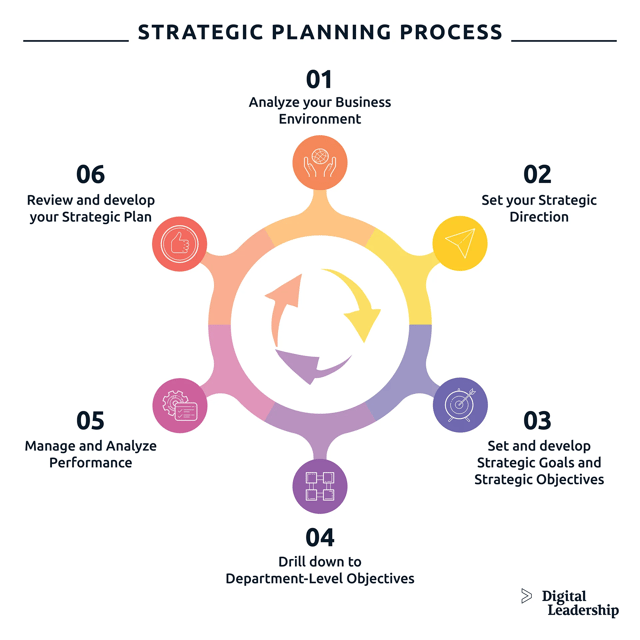
Digital business strategies fade out at a few predictable break points between strategy and execution.
Most leadership teams we meet have a digital strategy. It was discussed in workshops, approved by the board and presented to the organisation. A year later, the initiatives look different from the plan, and nobody can say exactly when the strategy stopped steering them.
That happens at four points. The strategy ends at the slide deck, decisions lose their link to it, the plan meets reality untested, and the work takes longer than the situation it describes. A strategy delivers measurable results when it holds at all four, and we built Axibra around exactly these points.
What a Digital Business Strategy Is Supposed to Deliver
A digital business strategy answers one question: how will digital capabilities change the way your company creates value? The answer only counts when it shows up in results.
Those results are concrete. A new revenue stream, a shorter process, a product that reaches customers earlier. Each of them can be measured, and each of them depends on decisions taken months after the strategy was written.
That is why the plan itself is rarely the problem. Most strategies we see are well reasoned. They name the right markets, the right capabilities and the right priorities.
The value is lost later, in the many small decisions that turn a direction into initiatives, budgets and teams. Every one of these decisions either carries the strategic intent forward or replaces it with something else.
A useful test for your own strategy is simple. Take one initiative that is running today and try to follow its line back to a specific strategic goal. If that line is clear, the strategy is still steering. If it breaks somewhere, you have found one of the four points this article describes.
The gap between strategy and results has a name, the strategy execution gap. It is rarely one large failure. In most companies it is a series of small losses that happen at the same places again and again.
Break Point One: The Strategy Stops at the Slide Deck
The first break point appears right after the strategy is approved. The document contains goals and priorities. It rarely contains the steps that turn them into work.
This leaves a gap that someone has to fill. In most companies, the delivery teams fill it themselves, often months later and without the context of the original discussion.
Each team translates the strategy into its own initiatives. Each translation is reasonable on its own terms. Taken together, they drift apart, because nobody worked out how the goals break down into concrete projects with clear owners and dependencies.
We see the same pattern across industries. A strategy sets the goal of making the company data-driven. One team buys a platform, another one starts a training programme, a third one builds dashboards. All three can point to the strategy, and none of them can say how their work adds up to the goal.
The cause is structural. Strategy work usually ends when the document is approved, and execution planning starts in a different place, with different people and different tools.
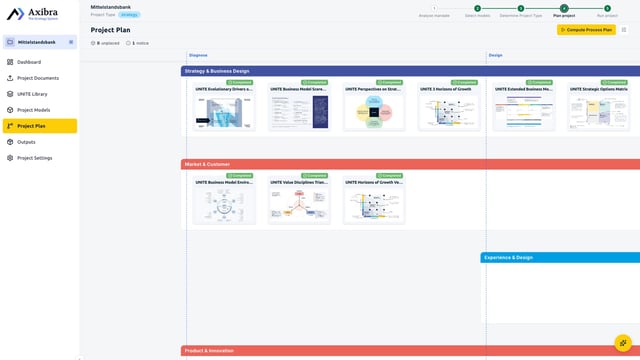
A strategy that is worked out down to execution looks different. It names the initiatives, the order in which they build on each other, and the capabilities each of them needs. It shows which goal every initiative serves.
That level of detail takes effort. Without it, however, the strategy remains a direction, and directions are interpreted differently by every team that receives them.
Break Point Two: Nobody Can Trace a Decision Back to the Strategy
The second break point is harder to see. Initiatives are running, budgets are spent, and the teams are busy. The question is whether anyone can still explain why a specific initiative exists.
In many companies nobody can. The reasoning behind a priority lives in workshop notes, in emails and in the heads of the people who were in the room. When those people move on, the reasoning leaves with them.
This has a direct effect on execution. When an initiative runs over budget, nobody can check whether it is still worth its cost relative to the goal it was meant to serve. When two initiatives compete for the same team, nobody can compare them against the strategy, because the link to the strategy was never recorded.
Priorities then drift towards whoever argues most convincingly in the next steering meeting. The strategy loses its authority without anyone deciding to abandon it.
With traceability, every initiative carries a recorded link to the strategic goal it serves, and every decision carries the reasoning that led to it. A change in one place shows its consequences in the others.
We treat traceability as a core capability of a strategy system for exactly this reason. A strategy that cannot be traced cannot be steered, and a strategy that cannot be steered will be replaced by the sum of local decisions.
Break Point Three: The Plan Is Never Tested Before It Meets Reality
The third break point concerns timing. Most digital strategies are tested for the first time when they are already being executed.
By then, budgets are committed and teams are staffed. Every flaw that becomes visible now is expensive to correct, because correcting it means stopping work that has already started.
The flaws themselves are often predictable. Two initiatives depend on the same scarce capability. A sequence assumes that one project finishes before another one starts, while the plan schedules both in parallel. A goal relies on an assumption about the market that nobody wrote down, so nobody checks it.
None of these problems is hidden. They are simply not visible in a strategy document, because a document does not run.
Other disciplines solved this long ago. Engineers simulate a design before they build it, and finance teams run scenarios before they commit capital. Strategy work is one of the few disciplines where the first real test is the rollout itself.
A strategy that can be tested in simulation changes that order. Dependencies, sequences and capacity conflicts become visible before the first euro is spent. Your team can compare variants, adjust the plan and then commit, with the weak points already known.
Run one real decision through the system
Bring a live strategy problem — a market entry, a transformation case. We show it as one linked object: the decision, its rationale, the assumptions it depends on, and the workstreams underneath it.
Book a demo20 minutes · with a strategist, not a sales repBreak Point Four: Strategy Work Takes Longer Than the Market Allows
The fourth break point is time. A classic strategy process runs through analysis, workshops, alignment rounds and board approval. For a digital strategy, that sequence often takes several months.
During those months, the conditions change. A competitor launches a product, a technology becomes cheaper, a regulation is adjusted. The strategy that reaches the organisation was built for a situation that no longer exists in that form.
Teams notice this quickly and start to adapt the plan on their own. That brings back the first two break points: initiatives without a worked-out structure and decisions without a traceable link to the goal.
Speed alone does not solve the problem. A strategy produced quickly but kept abstract only moves the real work to the delivery teams.
What your team needs is a way to reach a high-quality strategy faster, one that is already worked out down to execution when it is approved. That combination is rare in classic strategy work, because depth and speed compete for the same scarce resource: the time of experienced people.
The way out lies in method. When the steps of strategy work follow a codified methodology, experienced people spend their time on decisions instead of on rebuilding the same structures in every project. Your team does not start from a blank page.
What It Takes for a Digital Strategy to Produce Measurable Results
The four break points point to four conditions. A digital strategy produces measurable results when it meets all of them at the same time.
The first condition is executable detail. The strategy is worked out down to initiatives, sequences, capabilities and responsibilities before it is approved. Delivery teams receive a plan they can execute, and they do not have to reinvent the strategy on their own.
The second condition is traceability. Every initiative carries a recorded link to the goal it serves, and every decision carries its reasoning. When people change roles, the reasoning stays in the system of record.
The third condition is testability. The strategy can be run in simulation before rollout, so dependencies, conflicts and weak assumptions become visible while changes are still cheap.
The fourth condition is speed. The strategy reaches the organisation while the situation it describes still exists.
These conditions depend on each other. Executable detail without traceability produces plans that drift. Traceability without simulation records flaws instead of preventing them. Speed without the other three produces abstract strategies faster.
There is one more property that holds the four together, and that is determinism. A deterministic process produces the same result from the same input. For strategy work, this means that two teams applying the same method to the same situation arrive at the same structure, and that every result can be reproduced and checked.
Determinism makes strategy quality a property of the method, which your team can inspect, improve and repeat, whoever happened to be in the room.
How Axibra Closes the Gap Between Strategy and Execution
We built Axibra, The Strategy System, around exactly these conditions. Axibra treats strategy as something that has to run, which is why every part of it is built for execution.
The foundation is determinism. Axibra works with codified methodology, so the same input leads to the same strategic structure. Your team can reproduce every result and trace how it came about.
The second element is traceability. Every initiative in Axibra is linked to the goal it serves, and every decision keeps its reasoning. When a priority changes, you see which initiatives are affected and why they existed in the first place.
The third element is speed with depth. Axibra makes it possible to reach high-quality strategies much faster, and these strategies are worked out down to execution. Delivery teams receive initiatives, sequences and responsibilities instead of a list of themes.
The fourth element is simulation. Strategies in Axibra can be tested in simulation before rollout. Your leadership team sees dependencies and conflicts before budgets are committed, and it can compare variants of the plan against each other.
With these four elements, the strategy does not stop at the slide deck and decisions stay traceable. The plan is tested before it meets reality, and the work fits into the time the market allows.
You can see how this works in practice on our page How it works. The glossary explains the underlying idea of deterministic AI in more detail.
What Leaders of Digital Strategy Should Check
Before your company commits budget to a digital strategy, the four break points offer a short checklist. Each question can be answered with yes or no, and each no marks a place where the strategy is likely to fade out.
The checklist works for a new strategy as well as for one that is already running. For a running strategy, it shows where results are being lost today.
We recommend going through it with the people who will execute the strategy, since they see the gaps first.
- Is the strategy worked out down to initiatives, sequences and responsibilities, or does it stop at goals and themes?
- Can every running initiative be traced back to a specific strategic goal, with the reasoning recorded?
- Has the plan been tested in simulation before rollout, so that dependencies and conflicts are known?
- Did the strategy reach the organisation while the situation it describes still exists?
- Is the process deterministic, so that the result can be reproduced and checked by someone who was not in the room?
Axibra. The Strategy System.
About the author: Stefan F. Dieffenbacher is Founder & CEO of Digital Leadership AG and author of “How to Create Innovation” (Wiley, 2024 · Chinese edition: China Industry & Commerce Press, 2026). More about Stefan.
Frequently asked questions
A digital business strategy describes how digital capabilities change the way a company creates value. It only counts when it shows up in measurable results, such as a new revenue stream, a shorter process or a product that reaches customers earlier.
They rarely fail in the plan itself. They fade out at four break points: the strategy stops at goals and themes, decisions cannot be traced back to it, the plan is never tested before rollout, and the strategy work takes longer than the market allows.
A strategy can be run in simulation before rollout. Dependencies, sequences and capacity conflicts then become visible while changes are still cheap, and your team can compare variants of the plan before committing budget.
Traceability means that every initiative carries a recorded link to the strategic goal it serves, and every decision keeps the reasoning that led to it. When priorities change or people change roles, the reasoning stays available and the strategy remains steerable.
A deterministic process produces the same result from the same input. For strategy work, this means that the same method applied to the same situation leads to the same structure, so every result can be reproduced and checked.
Axibra is The Strategy System. It combines determinism, traceability and simulation, so that companies reach high-quality strategies much faster, worked out down to execution and tested before rollout.
Book a working demo of Axibra
Not slides about the product — the product. Bring one real strategy decision; leave with a traceable artefact that still holds its reasoning three layers down.
Book a demoPrefer to look first? Apply for priority access →