Axibra brings together three old, worthy words: axis, axiom and algebra. Axis stands for alignment, axiom for principles you can build on, and algebra, from the Arabic al-jabr, for the art of putting broken parts back together. Together they describe what strategy has always been missing, and what Axibra, the Strategy System, is built to provide.
Here is the story behind the name.
What does Axibra mean?
Axibra is the name of our strategy system. It carries three words, each with a long history and a clear job:
- Axis (Latin: axle, pivot): alignment. Every initiative, every decision and every team on one axis, from ambition to outcome.
- Axiom (Greek axíōma, from axios, “worthy”): foundation. Principles sound enough to build on.
- Algebra (Arabic al-jabr, “the reunion of broken parts”): cohesion. A system of rules that joins what strategy breaks apart.
Put the three together and you get Axibra: aligned, grounded, whole.
Why strategy needed a system
Every business function has its system. Finance has ERP. Customers have CRM. Supply chain has its planning systems. Strategy, the most consequential work a company does, still runs on slides, email threads and the memory of whoever was in the room.
The results show it. According to BCG research across more than 850 companies, only about 35% of transformations reach their goals (a correlational finding). Bain’s Transformation & Change Survey 2024 found that 88% of transformations miss their original ambition.
For fifteen years we made strategy work one company at a time, in strategy, innovation and transformation cases across Europe and beyond. We saw the same pattern again and again. The advice was never the problem. That it could not be repeated was. The strategy was right, and the reasoning behind it walked out of the building with the people who made it.
That gap between the strategy on paper and the result in the market is what practitioners call the strategy execution gap. Closing it takes more than a better slide deck. It takes a system. When we set out to build that system, we wanted a name that says what it does. Three words kept coming back.
Axis: alignment from ambition to outcome
An axis is the line everything turns around. The Latin axis meant the axle of a wheel, and also the imaginary line around which the earth and the sky turn.
Strategy works the same way. It only holds when every initiative, every decision and every team turns around one shared axis, from the ambition at the top to the outcome in the market. Most strategies do not fail for lack of ambition. They fail because the parts start spinning around different centres: one team optimises for cost, another for growth, a third for a deadline that nobody connected to the goal.
Axibra keeps initiatives, the decisions inside them and the reasoning behind those decisions in one place. They stay there when the people change. That is the axis.
Axiom: principles worth building on
An axiom is a principle so sound that you can build on it without proving it again every time. The word comes from the Greek axíōma, “that which is thought worthy”, and from axios, “worthy, weighty”.
The axioms behind Axibra are the UNITE methodology: fifteen years of codified methodology, tested in the field. It began as a research programme long before it became software. We did not start from scratch. Where an established practice already worked, we integrated it. The published work draws on more than 600 sources. More than 60 co-creators worked on the body of knowledge itself, and more than 200 people contributed to and reviewed the individual models.
The result was published by Wiley in 2024 as How to Create Innovation and became a bestseller. A Chinese edition followed in 2026 with China Industry & Commerce Press in Beijing. The UNITE models themselves, more than 200 of them and growing, have been downloaded more than 100,000 times, without a marketing budget.
This is what Axibra stands on. Your team does not start with a blank page. It starts with principles that have already earned their place.
Run one real decision through the system
Bring a live strategy problem — a market entry, a transformation case. We show it as one linked object: the decision, its rationale, the assumptions it depends on, and the workstreams underneath it.
Book a demo20 minutes · with a strategist, not a sales repAlgebra: putting broken parts back together
Algebra may be the most surprising of the three words, and it carries the deepest idea.
The word comes from the title of a famous treatise written in Baghdad in the 9th century by the mathematician al-Khwarizmi. In Arabic, al-jabr means “the reunion of broken parts”. In 15th and 16th century English, the same word was even used for setting broken bones.
That is exactly where strategy breaks. Initiatives rarely fail inside a single discipline. Excellence exists in strategy, in design, in business modelling, in operations, in structure and in culture. But a real initiative travels from customer needs to business models, to operating models, to organisational structure and culture, and it fails in the crossings between them. Nobody teaches the crossing.
Algebra is also a system of rules: it turns what is given into a result that anyone can follow and check. That is the promise of a strategy system. Not a clever answer that only its author understands, but a result whose reasoning you can retrace, step by step.
One more thing: the name also says “unite”
There is a quiet detail in the name. Al-jabr says as a noun what our methodology says as a verb: unite.
UNITE is the name of our methodology, and it keeps its name. Axibra is the system built on it. The software carries the same idea as the method, joining what belongs together, without borrowing its name. That is why you will find Axibra described as the Strategy System, built on the UNITE methodology.
From fifteen years in the field to the Strategy System
The name came last. The story started much earlier.
- The reasoning walked out with us. For fifteen years we made strategy work one company at a time, in automotive, banking, pharma, retail and technology. The strategy was right, and the reasoning left with us.
- The missing system. Finance has ERP, customers have CRM, strategy has folders. Initiatives fail between disciplines.
- First the method. UNITE, built with hundreds of contributors, published by Wiley, downloaded more than 100,000 times.
- Then the system. Axibra Results is the System of Record for Strategy. The engine does the heavy lifting. Your people own the judgement, and the capability stays in the house.
- The name. Axis, axiom, algebra: alignment, foundation, and the discipline that puts back together what strategy breaks apart.
Most strategy never arrives. That is not a law of nature. It is a missing system. As our manifesto puts it: by 2030, running strategy without a system will look as absurd as running finance without ERP.
Axibra. The Strategy System.
About the author: Stefan F. Dieffenbacher is Founder & CEO of Digital Leadership AG and author of “How to Create Innovation” (Wiley, 2024 · Chinese edition: China Industry & Commerce Press, 2026). More about Stefan.
Frequently asked questions
Axibra brings together three words: axis, axiom and algebra. Axis stands for alignment, axiom for principles you can build on, and algebra, from the Arabic al-jabr, “the reunion of broken parts”, for putting back together what strategy breaks apart.
Axibra is pronounced ak-SEE-bra, with the stress on the second syllable.
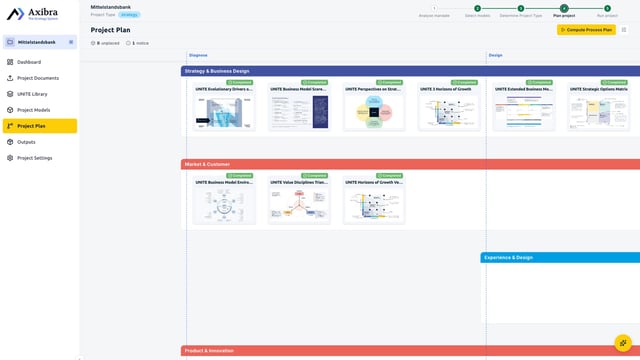
Axibra is the Strategy System by Digital Leadership. Its practitioner environment, Axibra Results, is the System of Record for Strategy: initiatives, the decisions inside them and the reasoning behind those decisions live in one place, and they stay there when the people change.
No. UNITE is the methodology: the models, the body of knowledge and the book “How to Create Innovation”. Axibra is the software built on the UNITE methodology.
A strategy system does for strategy what ERP does for finance and CRM does for customer relationships. It gives strategic work a single place where goals, initiatives, decisions and their reasoning are kept, connected and carried through to the outcome.
Axibra is built by Digital Leadership AG, founded by Stefan F. Dieffenbacher, author of “How to Create Innovation” (Wiley, 2024 · Chinese edition: China Industry & Commerce Press, 2026).
Book a working demo of Axibra
Not slides about the product — the product. Bring one real strategy decision; leave with a traceable artefact that still holds its reasoning three layers down.
Book a demoPrefer to look first? Apply for priority access →