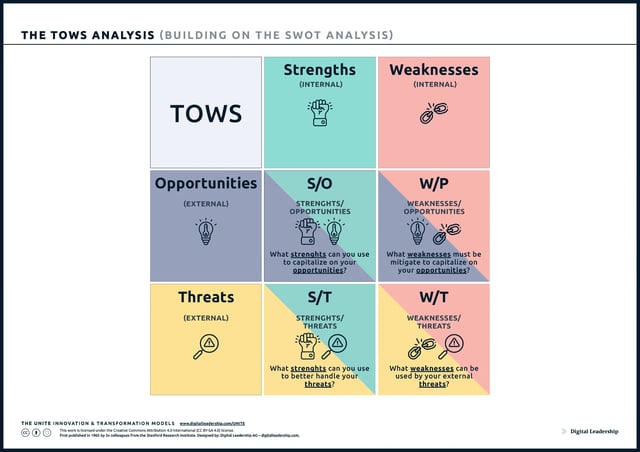
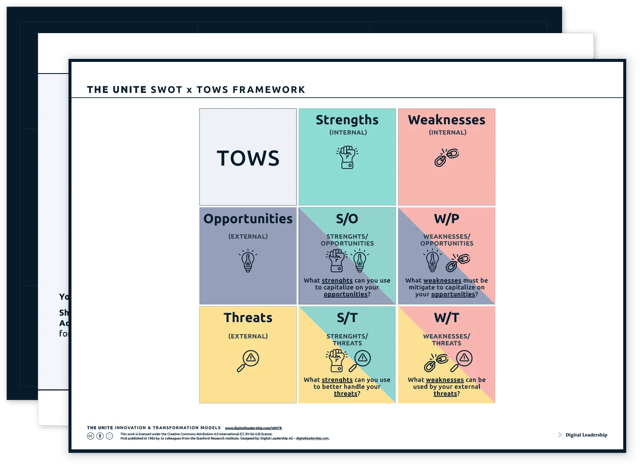
Different arrangements for the same words – Strengths, Weaknesses, Opportunities, Threats – the SWOT/TOWS analysis framework explores internal and external forces that influence your business.
The package
The case
It can be challenging to gain a full understanding of all the forces that affect your business's success and failure. The SWOT and TOWS Matrices and Analyses push us to look inward as well as outward to see all challenges as opportunities for growth. We should also recognize that current success is not guaranteed to continue – there are always threats for which we must prepare and plan. The SWOT analysis framework provides a broad view of the forces working for and against our business, while the TOWS framework makes room for practical strategizing. Taken together, we get a useful, comprehensive description of the environments in which we are working, and we are put in a position to best leverage opportunity and overcome challenges.
The mechanics
'Although they are connected, SWOT and TOWS analyses are distinct. In the SWOT Matrix, you consider Strengths, Weaknesses, Opportunities, and Threats as they relate to your organization. This is an initial analysis that requires you to consider the environment within your business as well as the circumstances without. The TOWS Matrix takes the analysis one step further, adding another layer to the matrix to create fields that combine the SWOT categories: Strengths/Opportunities, Weaknesses/Opportunities, Strengths/Threats, and Weaknesses/Threats. In these fields, you enter actionable strategies that take the combinations into account. For example, consider how you can respond to Threats that target your Weaknesses to mitigate potential damage. In both analyses, you’re asked to investigate your entire business model and all operations, perhaps more thoroughly than you would otherwise. As a result, you can prepare and plan in a manner that best positions your organization for success.
The purpose
What is the goal of the model?
Through the SWOT/TOWS Matrix, we identify and respond to internal and external forces that influence – for good and for bad – how our business performs.
Beyond the download
The PDF is yours to keep. But a model changes something only when it touches the work — and that is what Axibra does with it. The model becomes the structure your decisions are made in, and every outcome stays traceable back to the input it came from.
Thousands of organizations leverage the UNITE models — these are some of them …












By subject

From here on
Axibra is where these models run. It carries a decision through to the work that follows it, and keeps every result traceable back to the input it came from. If you would rather start with a conversation, we are one call away.
Strategy does not fail in the thinking. It fails in the handover.
Stefan F. DieffenbacherFounder & Managing Director of Digital Leadership