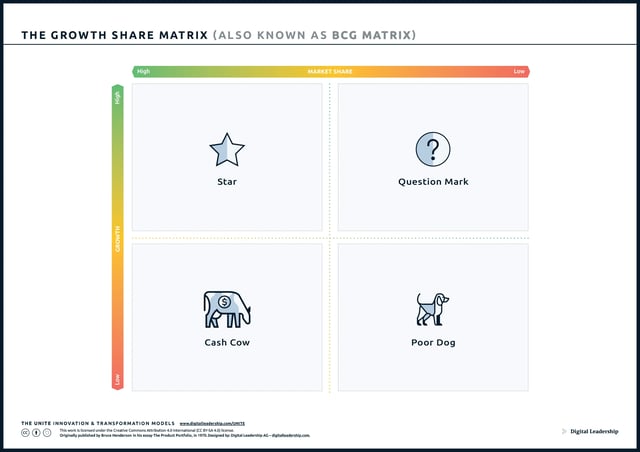
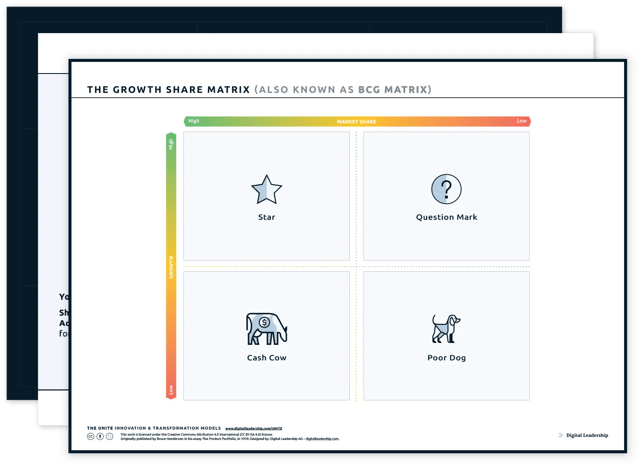
The Growth Share Matrix (also known as BCG Matrix after the Consulting firm Boston Consulting), is a tool for portfolio management based upon a businesses’ growth prospects and it's existing and potential market share.
The package
The case
Overall, the The Growth Share Matrix (also called "BCG Matrix") is used to identify growth opportunities and avoid poor investments. The focus is on competitiveness and the possibilities available in the market. The BCG Matrix pushes businesses to plan how they’ll develop their products and services going forward to maximize profit potential.
The mechanics
To complete a BCG Matrix, label one axis Growth and the other Market Share, and then divide each into Low and High segments. You’ll have a four-field diagram as a result: High Growth/High Market Share (Stars); High Growth/Low Market Share (Question Marks); Low Growth/High Market Share (Cash Cows); and Low Growth/Low Market Share (Question Marks). Analyze each of your investments, and place them into the appropriate quadrant. Honestly evaluate which of your Cash Cows and Stars are threatened and decide how you will respond. Additionally, decide if further investment in Question Marks makes sense and articulate your expectations and limitations for those projects.
The purpose
What is the goal of the model?
The goal of the BCG Matrix is to identify areas of potential investment and interests more-suitably abandoned from within a business's portfolio in order to maximize profits.
Beyond the download
The PDF is yours to keep. But a model changes something only when it touches the work — and that is what Axibra does with it. The model becomes the structure your decisions are made in, and every outcome stays traceable back to the input it came from.
Thousands of organizations leverage the UNITE models — these are some of them …













By subject

From here on
Axibra is where these models run. It carries a decision through to the work that follows it, and keeps every result traceable back to the input it came from. If you would rather start with a conversation, we are one call away.
Strategy does not fail in the thinking. It fails in the handover.
Stefan F. DieffenbacherFounder & Managing Director of Digital Leadership